Semantic change units
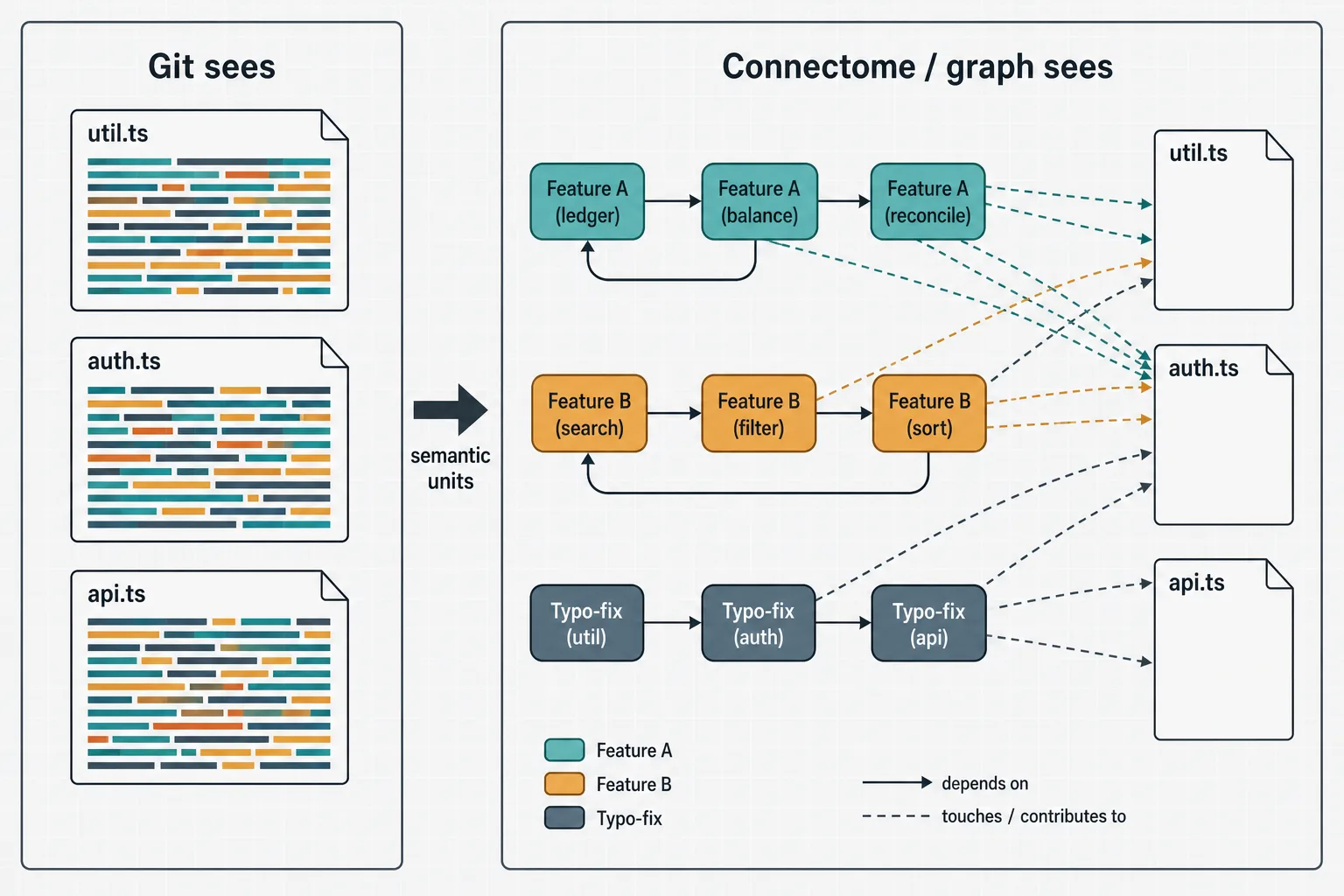
Git is excellent at what it models: a content-addressed blob ledger plus a commit DAG over tree snapshots. It is awkward at what developers actually edit: features, fixes, and dependency edges that cut across files—and sometimes share a file with unrelated neighbors.
That mismatch is not a skill issue. It is a missing layer of meta-information. Connectome-fs exists to make that layer native: GUID-addressed nodes, typed associations, and editions—so hierarchy stays a navigation slice and the graph stays truth.
Two silences in Git’s model
Unrelated features inside one file
A single utils.ts often hosts several independent units of work: formatDate, parseFlags, a one-line typo in a helper name.
Git’s first-class commit unit is still “these paths at this tree.”
Partial commits (git add -p) and virtual-branch tools paper over hunk assignment, but the object model never learns that two functions were orthogonal features.
The history cannot answer “give me every change that belonged to feature B” without human archaeology of hunks and messages.
Dependencies between files
Build systems and language servers know that api.ts depends on auth.ts.
Git does not.
A pull that updates an interface in one file and a call site in another is two path diffs with no edge.
Merge tools reconcile bytes; they do not carry a dependency graph that could say “these edits travel together” or “these edits cannot conflict because they do not share a semantic neighborhood.”
Team sync as false coupling
The everyday ritual:
-
Alice commits a typo fix in
formatDate. -
Bob is mid-edit on
parseFlagsin the same file—an unrelated function. -
Bob
git stash,git pull,git stash pop. -
The tool surfaces a conflict or a noisy diff because the file changed, not because Bob’s feature depended on Alice’s typo.
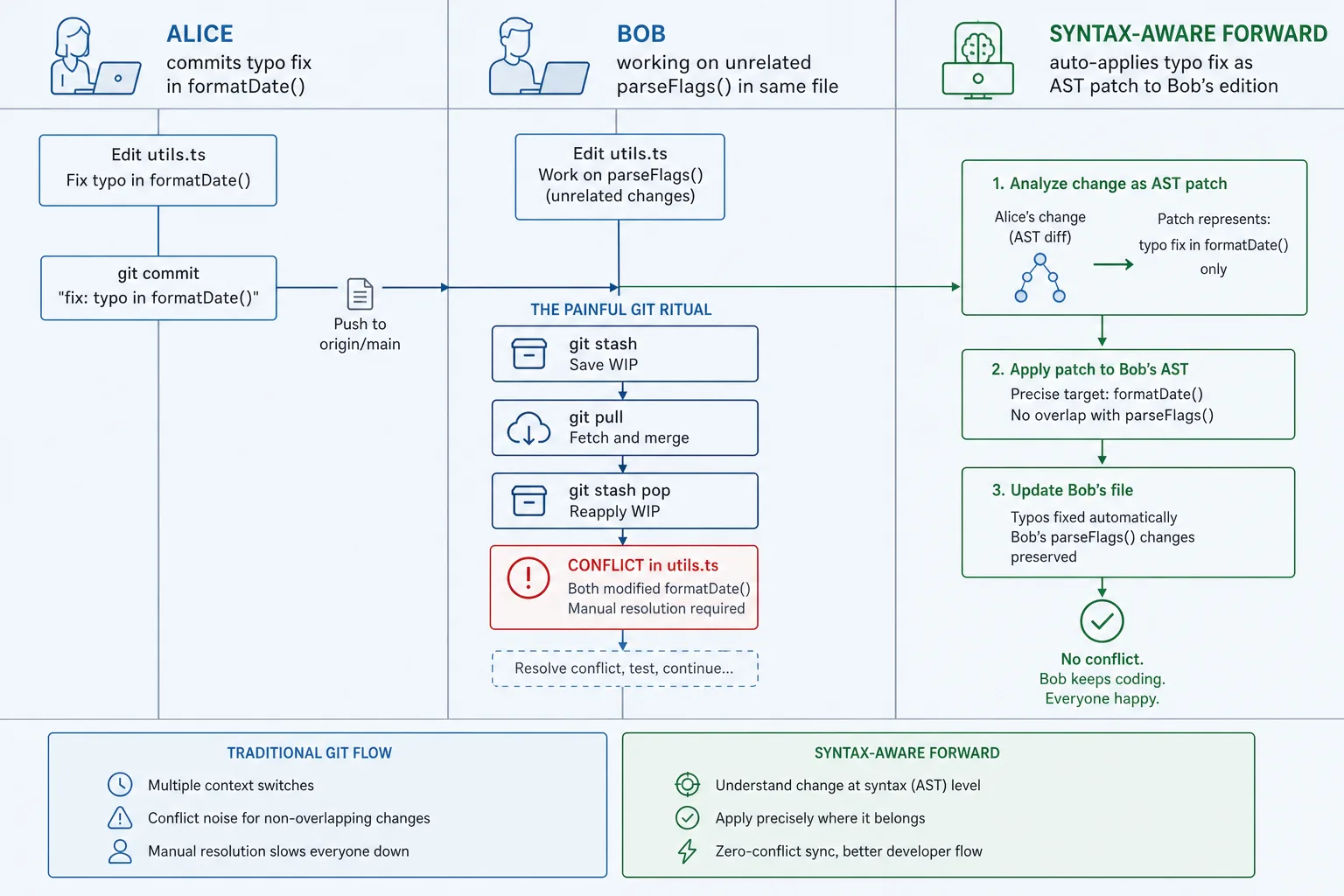
The second person was not touching the system Alice changed. Git has no way to know that. File identity is the only coupling it trusts, so unrelated work collides at the blob boundary.
What a graph / dependency model adds
A connectome-shaped store can treat:
-
Functions, types, modules, docs, and assets as addressable nodes (or finer grains as the language binding matures)
-
depends-on, implements, generated-from, related-to as first-class edges
-
Editions as process-scoped bindings over the same path string (see Editions)
-
Commits as graph transactions: “these semantic units advanced,” not only “these paths hashed differently”
Version control then shrinks toward remote sync, review policy, and semantic merge—see VCS collapse over editions—instead of owning working trees and pretending files are features.
Unison and friends
Unison attacks a sibling problem from the language side: definitions are content-addressed; rename and refactor become graph operations rather than text churn across a tree of files. That is the right unit of identity for code meaning.
Connectome-fs aims at the filesystem and association plane underneath many languages and non-code artifacts—so dependency and edition metadata are not trapped inside one runtime. Unison shows the destination for code; connectome-fs is the substrate that should make “feature as node” ordinary even when the editor still shows folders.
Syntax-aware auto-forward
Some changes are morally broadcasts: fix a typo in an identifier, tighten a docstring, reformat within an AST node with no semantic shift. In a file-diff world, those broadcasts still collide with anyone editing the same path. In a syntax-aware graph world, the patch attaches to a node id and can auto-forward into peer editions when the merge engine proves non-interference (same definition identity, no overlapping semantic edit).
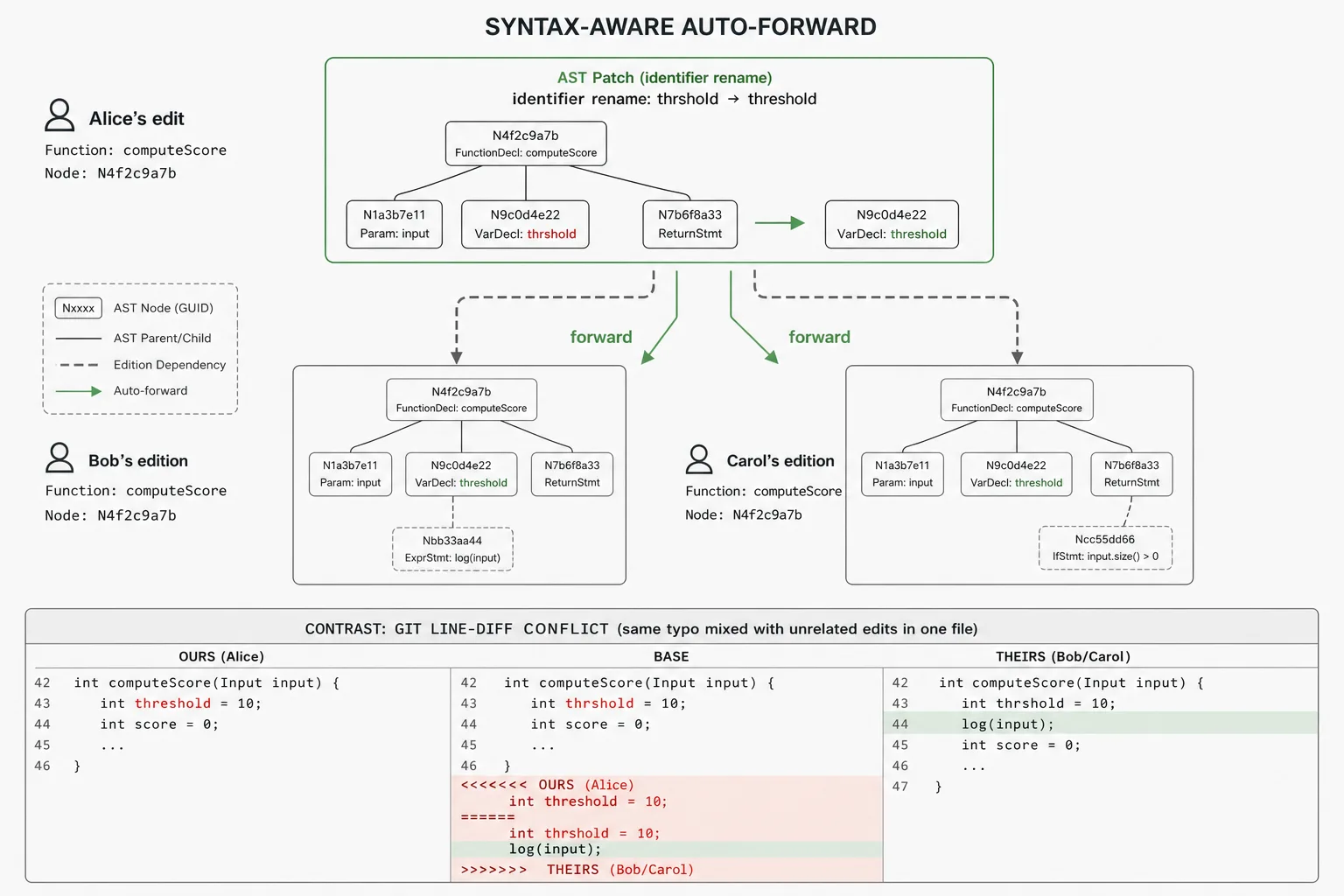
That is not replacing human review for behavioral changes. It is refusing to punish teammates for orthogonal work—or for sharing a file with a typo.
Relationship to concurrency editions
VCS collapse and the Dev-Centr essay on Git concurrency enshittification focus on many live trees (worktrees, virtual branches, Phase A bridges, filesystem editions).
This page focuses on a different cut: even with one tree, Git’s unit of change is wrong for feature work. Editions without semantic units still merge blobs. Semantic units without editions still thrash working copies. Together they explain why modern Git UX keeps inventing escape hatches—and why the durable fix is graph-native storage.
Onboarding is a third cut: even with correct feature identity, a stranger still needs an evolutionary walk and a compositional map — see Pathogenesis and composition.